wGrow Labs/Engineering
The engineering bench behind every lab venture.
Eighteen years of production. Still patched.
Our clients have included hospitals, grant-making bodies, law firms, financial platforms, manufacturers and consumer ecommerce. Most of those systems are still in production, and we still maintain them.
Delivering continuously since 2008
Production deployments under PDPA controls
Sectors, from healthcare to the data centre
Longest client whose systems we still patch every month
AI engagements live in production
Offices: Singapore, Johor Bahru, Jakarta
Figures as published by wGrow Technologies at wgrow.com.
Studio timeline · 2008 → 2026
Stack · 18 years, still patched. Gold tags are the governance frameworks we build to.
Six steps. One human gate. Weekly releases.
Every engagement runs the same loop. The first three steps close in week one. The first crew is usually running in two to three weeks, and after that we ship every week. Every release is checked against an evaluation suite.
- 01
Brief
Scope, constraints and the regulator.
- 02
Diagnostic week
Crew shape, evaluation plan and release cadence.
- 03
Crew + eval
Narrow agents and a working evaluation harness.
- 04
Build
A release every week, each one gated by evaluation.
- 05
Human gatenever skipped
A person approves, edits or rejects. This step is never skipped.
- 06
Long-term support
Maintain, patch and watch for evaluation drift.
Typical engagement cadence, first eight weeks
Fig. 01The cadence stated above: steps 01–03 close in week one, the first crew is usually running in weeks two to three, then an eval-gated release every week, each passing a human gate. Illustrative, not a schedule for a specific venture.
# studio rules — every crew, every venture
1 agent : 1 narrow job
1 crew : 1 outcome
1 human : 1 final approval
1 eval : every commit, no exceptions
We don't ship “an AI agent.” We ship crews.
A single agent in production is fragile. A small crew is something you can ship and audit: narrow agents, a real evaluation harness and a named human who approves the result.
Governance
Built to the governance buyers will ask about.
We build to Singapore's PDPA and to IMDA's Model Governance Framework for Agentic AI. Every crew has role-scoped autonomy, audit logs and a human approval step from day one, not added after launch. For lab ventures selling into regulated industries, the controls a customer will inspect are already in place.
- Singapore PDPA
- IMDA agentic AI framework
- Role-scoped autonomy
- Audit logs
- Human approval step
- From day one
WaterDoctor: agentic AI running real treatment tanks.
WaterDoctor is a Singapore deep-tech company founded by NUS PhD researchers. It builds AI-integrated biofilm reactors for water treatment and aquaculture. Since 2024 we have designed, built and operated the agent crew that runs its adaptive treatment loops in production. We are its strategic technology partner, not a vendor.
Pilot outcomes vs prior baseline
Fig. 02Outcomes reported by WaterDoctor across pilot tanks, compared with the prior baseline.
Source: WaterDoctor's public communications at waterdoctor.com.sg
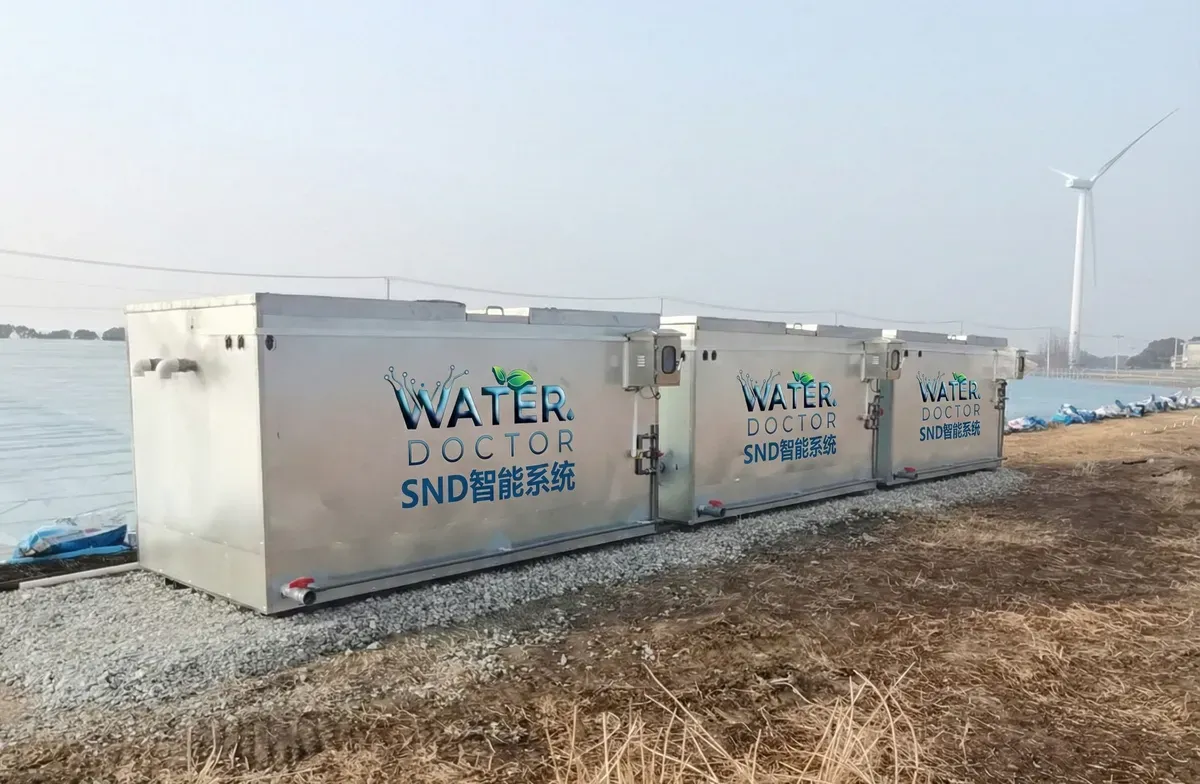
In the field
WaterDoctor treatment units on site. The crew runs the loop behind them.
Crew shape: four narrow agents, two engineers, one safety envelope
Fig. 03Source: Stack: sensors → claude-code → MS SQL · PDPA · aligned with IMDA's agentic AI framework · weekly release · live since 2024
The problem
Biofilm water treatment is continuous and noisy. Sensor readings drift, the biology adapts and the weather changes the load. A fixed control schedule over-aerates when it should rest and reacts to symptoms while the microbial community shifts underneath. WaterDoctor needed a controller that learns the local process, and a way to show a regulator that the controller behaves.
What we got right
- Narrow agents. None of them has a job description that reads like a management role.
- Hard safety limits. The agent picks the moves; the engineers set the floor and the ceiling.
- Reports linked to raw data. No paraphrased number ever leaves the system.
- An evaluation harness from week one. Drift is treated as a signal, not found in a postmortem.
What we got wrong, and changed
- We started with one “ops agent”. It was too broad, so in week three we split it into ingestor, controller, reporter and eval.
- We underestimated lab-assay latency. Lab results arrive days after the sensor reading. We fixed it with a delayed-supervision channel.
- In week six, auto-tuned aeration was too aggressive. The guardrails caught it. We tightened the limits and now require human approval for any change of more than 15% from the rolling baseline.
ingestor.agent
In-tank probes (DO, pH, ammonia) plus lab assays
controller.agent
Treatment decisions inside safety limits set by engineers
reporter.agent
Run summaries a regulator can read, tied to the raw data
eval.agent
Continuous monitoring for deviation
2 × engineer
Senior wGrow engineers own the safety limits, the data schema and sign-off on every report that goes to a regulator
process science
WaterDoctor's scientists own the biology, a corridor away from the crew
Six crews at work now. Each with a human who signs.
These crews run inside the studio and for clients today. Lab ventures are built with the same patterns and the same discipline.
| Crew | What it does | Human gate | Status |
|---|---|---|---|
| WaterDoctor Crew | Sensor data drives adaptive treatment loops, which produce reports a regulator can read. It runs with an NUS deep-tech spinout. | Two senior engineers on the ground | Live |
| Article Crew | Nine stages and ten specialist agents. Every DOI is checked against Crossref and every URL is fetched live. | A human editor reads every piece | Live |
| BD Crew | Six scout agents sweep China, Southeast Asia and Singapore for grants, tenders and regulatory triggers. A verifier agent checks every claim against its source. | A BD owner promotes leads to the CRM | Live |
| Finance Crew | Monthly close, SFRS financial statements, and GST F5, Form C-S and ACRA filings. | A Chartered Accountant signs every figure | Active |
| Selection Crew | Scans a market category, ranks SKUs by price band, shortlists suppliers and flags compliance issues. | A buyer signs every shortlist before a PO | Active |
| Image Crew | Hero shots, lifestyle scenes and product variants, scored for brand fit and ready to list. | An art director signs off each set | Active |
Live: running in production. Active: in use on current engagements. The orange marker is the human gate.
From private models to the unglamorous layer.
AI ventures fail on the boring parts: security, encryption, patching and recovery. Those are the parts we have been doing since 2008.
Private LLM for a TV studio
We fine-tuned a DeepSeek base model on 3,000+ in-house scripts and deployed it on-premises for the writers' room. It is calibrated to the studio's house voice, format and continuity.
DeepSeek · fine-tune · private deploy
Server-ops agents on Claude Code
Log triage, deployment runs and incident commentary, wrapped in a hardened private bot. The reference architecture is public as ClaudeAgentBOT.
Ecommerce image and video pipelines
Product image variants, lifestyle stills and short-form video for marketplaces and ad creative. We use them in our own ecommerce R&D and on selected ecommerce engagements.
diffusion · short-form video · eval harness
Open-weights models on your hardware
GPU sizing, vLLM serving, Llama, Qwen, DeepSeek, GLM or Mistral, and LoRA fine-tuning. We build the evaluation set before training the weights; a fine-tune that doesn't beat the base model doesn't ship.
vLLM · LoRA/QLoRA · OpenAI-compatible API
Secure AI routing
A perimeter you operate, so engineers can use Claude Code, Codex CLI and Gemini CLI without data leaving through a public endpoint. It runs over a VPN, with outbound traffic controlled and every request logged.
VPN · egress control · audit log
CIS-benchmark hardening
Hardening of Linux and Windows Server to CIS benchmarks, monthly patch windows with tested rollback, log forwarding to a SIEM, and least-privilege access.
Ubuntu · RHEL · Windows Server 2019/2022
Long-running systems · still in production
Patient Management System
Multi-clinic records, appointments, lab integration, drug inventory and billing, with field-level encryption and audit trails.
AWS · MS SQL · PDPA · Singapore medical group
Grants Management System
End-to-end grant administration: applicant portal, expert review, claims handling, and audit controls that meet procurement requirements.
.NET · MS SQL · Singapore grant-making body
Hospital visitor logging
Audit-grade visitor sign-in for a Singapore hospital, with PDPA controls, retention windows and incident reporting built in.
.NET · MS SQL · Windows Server 2019
Named people, not a ticket queue.
Technical leadership comes from long-time collaborators who were in the same year at NUS School of Computing.
Timothy Mo
CEO · co-founder
Twenty years in IT delivery, much of it as a solution architect. NUS School of Computing, SMU Master's. Runs the embedded delivery crew day to day.
Scott Li
CTO · architect
NUS School of Computing, in the same year as Timothy. A long-time lead on wGrow engineering work and architecture.
The studio
SG · JB · Jakarta
Engineering and long-term support from Singapore, with delivery and field engineering in Malaysia and Indonesia for regional ventures.
Field notes
All field notesBegin the conversation
What important problem can you see more clearly than others?
You don't need a polished pitch deck. Send a short, non-confidential introduction: the problem, your connection to it, what exists today and what you want to build.
- 01
Tell us the opportunity
The problem, who pays to solve it, and where you need help.
- 02
We review the fit
Founder, problem, potential business, and where the lab can contribute meaningfully.
- 03
A private conversation
If there may be a fit, we discuss expectations and a possible build plan.
Contacting us does not constitute an offer or commitment to invest. Please do not send trade secrets, unpublished IP, credentials or confidential technical information at this stage.